
Sustainability and the sanitary industry Focus on durability, water efficiency and material savings
Water is essential for nutrition, hygiene and cleaning, and as a means of transportation. Our sanitary products make a key contribution towards meeting these basic needs. They are designed with a focus on a long service life and reduced water and material consumption. We have been a reliable partner for the sanitary industry for over 150 years.
For more than 30 years, we have consistently aligned our strategy with long-term considerations - along the entire product life cycle. This commitment is an important reason for the company's success. We believe that one of the greatest contributions to the careful use of resources is to continually set new standards for the quality and service life of products.
Many Geberit products are used for decades. In addition, the long-term availability of spare parts and the backwards compatibility of new products make an important contribution to their service life. In this way, we provide construction partners with specifications and documentation to assist them with the planning and verification of certified construction projects.
At a glance

Designed for durability
Thanks to high-quality materials and strict quality requirements, many Geberit products are designed to last for decades. They are also generally backwards-compatible and are easy to clean and maintain. Furthermore, Geberit ensures flushing functionality of concealed cisterns for 50 years, which means that the corresponding spare parts remain available during this period (with the exception of the specific functionalities of electronic products, such as the hygienic flush or DuoFresh).

Water-saving solutions
Geberit has a long tradition of manufacturing products, that reduce water consumption, particularly WC cisterns and their components. According to a model calculation, water consumption for toilet flushing has been reduced by around 80% from 70 to 14 litres per person per day since 1952 thanks to several innovations such as Geberit dual-flush and stop-and-go cisterns.
Creating added value with eco-design
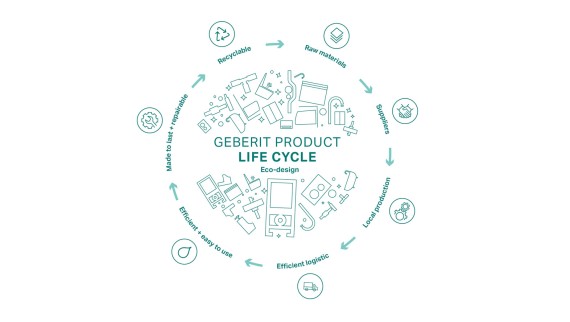
Since 2007, all products have been consistently developed according to the eco-design principle: Every new product should outperform its predecessor in terms of relevant environmental indicators - without compromising on quality, functionality or durability. All stages of the product life cycle are considered, from raw material extraction to disposal. Since its launch, more than 200 products have been developed or optimised according to this principle.

Conscientious use of resources
In production, we aim to close internal material cycles, minimise waste and recycle it sensibly. Plastic is used as resource-efficiently and sparingly as possible to manufacture high-quality and durable products. As part of the eco-design workshops, efforts are being made to increase the proportion of purchased plastic regranulate (post-consumer waste) in the products.

Compact packaging
Geberit endeavours to keep the use of packaging material to a minimum. The company is gradually redesigning its packaging and reducing the amount of material required without compromising on product protection. Geberit's packaging strategy is aligned with the requirements of European packaging regulations. The aim is that plastic packaging contains at least 35% recycled material by 2030. In addition, 70% of the material used should be recyclable.

Reducing CO₂ emissions
Geberit has been systematically reducing its carbon footprint for years. Since the acquisition of the energy-intensive ceramics production in 2015, relative Scope 1 and Scope 2 CO₂ emissions, measured against currency-adjusted net sales, have been reduced by 69 per cent. In 2025, around 68 per cent of the electricity purchased came from renewable energy sources.

Certified production and logistics
All production plants of the Geberit Group, the logistics centre in Pfullendorf (DE), and the management company incorporating all Group functions at headquarters in Rapperswil-Jona (CH) are certified in accordance with ISO 9001 (quality), ISO 14001 (environment) and ISO 45001 (occupational health and safety). In addition, eight plants are certified in accordance with ISO 50001 (energy) and eight sales companies in accordance with ISO 9001 (quality).

Social responsibility
Geberit is committed to the human right to clean drinking water and basic sanitation through development projects. In partnership with the Hilti Foundation and Swisscontact, the company promotes the transfer of know-how and vocational training in Kenya with a vocational training programme for sanitary specialists. Around 150 young people are currently learning the sanitary profession at the training centre in Nairobi, while 44 have successfully completed the training. Geberit is also committed to equal opportunities and inclusive workplaces.
Environmental Product Declarations (EPD)
Environmental Product Declarations, or EPDs, are an important source of information for building owners, investors, business partners and other decision-makers. They provide information on the ecological footprint of construction products and are based on a detailed life cycle assessment.
Products with third-party EPDs account for 42% of Geberit's Group sales. This means that a transparent data set is available for a large part of the product range, which may be relevant for building certification schemes such as DGNB, BREEAM or LEED.
Download EPDs
| Bathroom products | Drainage piping systems |
|---|---|
| Geberit Sigma 01/10/20/30 actuator plates Geberit Duofix WC element | Geberit PE pipes Geberit PE fittings |
Selected products

Water-saving dual flush
Around one-third of daily water consumption in the home results from the toilet flush. An average of six to nine litres of water flow into the sewage system with each individual flush. It is therefore worth tackling this issue. By fitting a stop-and-go flush or dual flush, significant amounts of water can be saved compared to a single flush. Modern flush valves such as the Type 212 can also be set so they use a reduced flush volume.

Water-saving type 212 flush valve
The type 212 flush valve enables the WC ceramic to be flushed effectively using minimal amounts of water: from 4 litres for a full flush and from 2.6 litres for a partial flush. It is backwards compatible with all Sigma, Delta and Omega concealed cisterns.

Saving space and materials
A drainage system with Geberit SuperTube makes it possible to use pipes with smaller dimensions and to eliminate the ventilating pipe. This saves material in tall buildings.

Less material for roof drainage
According to a project example, Geberit Pluvia requires 73% less material weight for PE pipes and fittings compared to conventional roof drainage solutions (calculation according to DIN 1986-100).

Sigma20 actuator plate with recycled plastic
The mounting frames for the actuator plates are made entirely of recycled ABS plastic that has been recovered from electronic scrap. The Sigma20 actuator plate in white is 100 per cent recyclable.
UWLA Label
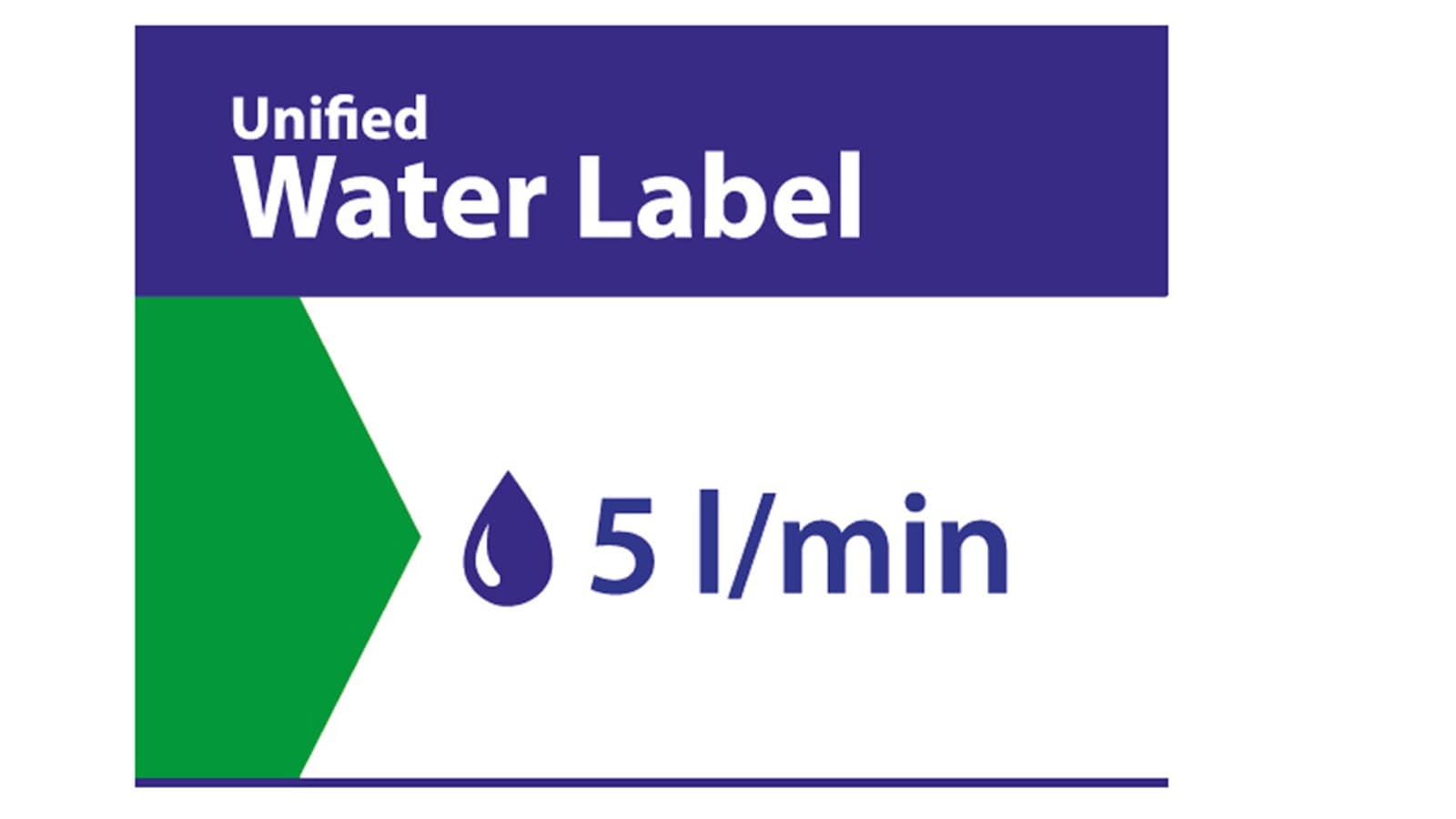
The Unified Water Label Association (UWLA) label is a voluntary industry label for sanitary products. It displays key figures on a product’s water and energy efficiency – whether it be a toilet, shower or tap.
This makes it easier to compare products that have been registered under the scheme. The criteria and testing procedures are documented on the UWLA website.
Technical documents – now digital instead of printed
Every year, technical documents like assembly instructions and catalogues generate enormous quantities of paper. That’s why Geberit is transitioning to digital formats.
By scanning a QR code or accessing the digital product catalogue, you can find everything you need, available in multiple languages and accompanied by helpful video instructions. Technical documents and installation videos can be found in the product catalogue on the page of the respective product.
This initiative is helping Geberit save over 1,000 tonnes of paper and 800 tonnes of CO₂ annually.
A binding sustainability strategy
More than 30 years ago, Geberit drew up its first environmental strategy and implemented specific measures. Over the years, this strategy has been gradually expanded into a comprehensive sustainability strategy. It is based on the UN Agenda 2030 and its 17 Sustainable Development Goals.
Four goals are particularly important to Geberit.


